Image of the day The Étang de Montady, southern France | COPERNICUS

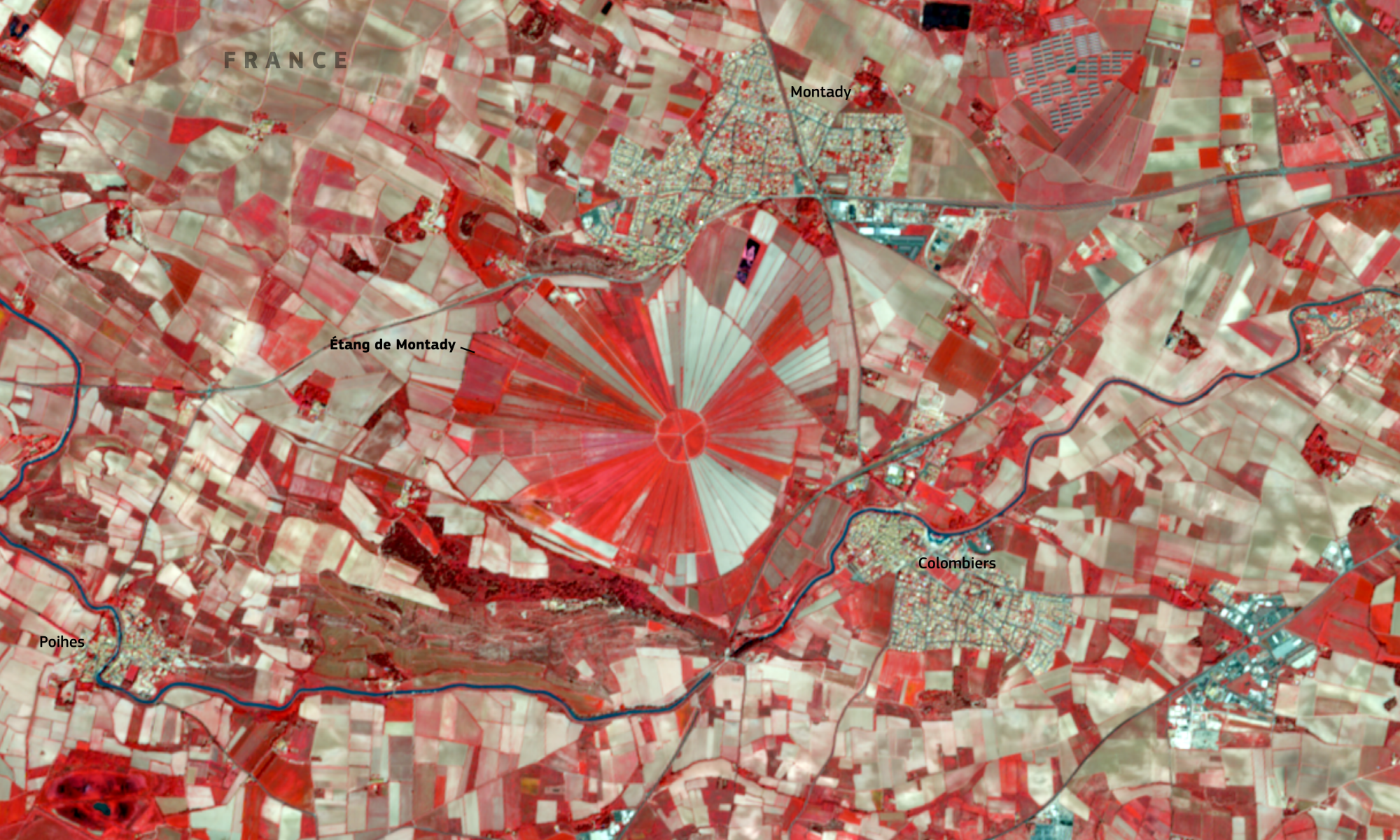
Le domaine de la Grande Courtade où “pousse” notre gamme PLAISIR, nos cuvées en IGP Pays d’Oc est passé sous l’oeil attentif de COPERNICUS.. nous vous racontons souvent ce terroir si particulier du “soleil vert” cet étang asséché au moyen âge.

Crédit : Union européenne, imagerie Copernicus Sentinel-2

L’étang de Montady, situé dans le sud de la France près de la ville de Montady, est un exemple remarquable de remise en état des terres au Moyen Âge. À l’origine une zone humide, il a été asséché au XIIIe siècle à l’aide d’un système radial de fossés convergeant vers un point de collecte central. Cette conception hydraulique ingénieuse a transformé la région en terres agricoles fertiles et créé un motif en rayons de soleil qui reste clairement visible aujourd’hui.

Cette image en fausses couleurs, acquise par l’un des satellites Copernicus Sentinel-2 le 11 mai 2024, montre la disposition radiale du paysage agricole entourant l’ancienne zone humide, entrecoupée de canaux et de routes.

Les données ouvertes des satellites Copernicus Sentinel sont essentielles pour surveiller l’évolution de l’utilisation des sols et la productivité agricole. Ces données permettent de suivre la dynamique saisonnière de la végétation et de soutenir la gestion durable des terres et de l’eau dans le monde entier.

Finaliste du concours Adelphe avec ” les intercalaires, c’est légendaire” !

Famille Fabre : Finaliste du Concours Millésime Adelphe 2025

La Famille Fabre, vignerons en Languedoc depuis 1605, a été sélectionnée parmi les finalistes du prestigieux Concours Millésime Adelphe 2025 dans la catégorie éco-conception. Ce concours récompense les initiatives innovantes et durables dans le secteur des vins, spiritueux, cidres et bières.

Et vous pouvez encore nous aider en votant pour nous ici :

Une innovation écologique

La Famille Fabre s’est distinguée grâce à son projet de réduction des emballages pour la palettisation des bouteilles de vin. En remplaçant les cartons traditionnels par des intercalaires à trous, ils ont réussi à réduire leur empreinte carbone tout en optimisant l’espace de stockage. Cette initiative permet non seulement de diminuer la quantité de déchets, mais aussi d’améliorer l’efficacité logistique.

Un engagement environnemental de longue date

Engagée dans l’agriculture biologique depuis plus de 30 ans et certifiée Haute Valeur Environnementale (HVE), la Famille Fabre met en œuvre des pratiques agroécologiques et d’agroforesterie pour cultiver des cépages adaptés au changement climatique. Leur démarche s’inscrit dans une volonté de préserver la biodiversité et de promouvoir une viticulture durable.

Vote du public et récompenses

Le concours Millésime Adelphe permet au public de voter pour les projets les plus innovants. Les lauréats recevront une enveloppe de 10 000€ pour financer leurs initiatives écologiques.

La Famille Fabre continue de prouver que tradition et innovation peuvent aller de pair pour un avenir plus respectueux de l’environnement.

Vous pouvez en savoir plus sur leur projet et soutenir leur candidature en visitant leur site dédié: https://www.adelphe.fr/

Famille Fabre unveils its new look and its new wine: Syrah Viognier

Famille Fabre unveils its new look and its new wine: Syrah Viognier

Famille Fabre marks a new chapter in its history by presenting the brand-new Syrah Viognier wine, accompanied by a fresh and bold visual identity. Straddling tradition and modernity, this red wine stands out for its light and aromatic character—a true ode to creativity and conviviality.

An unexpected blend that captivates the senses

Made from a unique blend of 80% Syrah and 20% Viognier, this wine demonstrates an original and harmonious marriage. The Syrah brings its fruity richness, while the Viognier adds a floral finesse.

On the nose, balsamic and minty aromas enchant from the very first encounter. On the palate, it’s an explosion of flavors with a gentle and generously fruity attack, blending blackcurrant and white flowers. The finish stands out for its freshness, silky tannins, and perfect balance. It’s a sensory experience that will delight curious wine lovers eager to explore a different side of the estate’s fine wines.

A striking new appearance

To complement this unusual wine, Famille Fabre collaborated with the talented illustrator @romane_nardreb. Together, they imagined a label that tells a story: a playing card where “Madame Syrah” and “Monsieur Viognier” come to life. This colorful and lively design reflects the very spirit of the wine, characterized by sharing, playfulness, and conviviality.

The experience continues beyond the glass

In keeping with this playful visual identity, Famille Fabre also offers an exclusive deck of cards. This is an original and festive way to extend the moment, whether during an aperitif with friends or a family evening. It’s not just a wine you’re savoring; it’s a shared moment of pleasure.

Syrah Viognier is much more than a wine: it’s an invitation to discover the boldness and expertise of Famille Fabre, through a creation that is both original and profoundly human.

New warehouse at château de Luc

Luc’s residents have notices over the last months all the renovation and construction works made at Famille Fabre ! After (finally) re-roofing the château and the winery, we’re now building a new hangar to absorb the surplus orders from our growing business. We’d like to thank all the craftsmen who worked on the site, and look forward to moving in next month!


Sheep again in our vineyard !

Having sheep in the vineyard has many advantages. Sheep grazing helps to keep vegetation under control in an environmentally-friendly way, reducing the need for herbicides and machinery.What’s more, sheep naturally fertilize the soil with their droppings, promoting soil health and biodiversity. Their presence also helps reduce the risk of fire by eliminating dry grass and maintaining a safer environment.

The return of the sheep to the Fabre family vineyards is a symbol of tradition and respect for the land. Using ancestral methods such as biodiversity and holistic management, they are restoring ecological balance while producing quality wines.This return testifies to their commitment to sustainable viticulture.

Integrated ecology with Famille Fabre

Here’s a non-exhaustive list of our ongoing, 360-degree vineyard initiatives! Work in permanent progress…

IN THE VINEYARDS
– We have planted southern grape varieties to accompany the global warming: Alvarinho, Tempranillo.
– A major agroforestry direction is given with over 5,000 trees planted in 3 years, together with hedges inside the vineyards. The fruits iare then transformed by André Fabre, son number 5 from Famille Fabre.  https://www.instagram.com/andrefabre_cidre/
– Integration of polyculture and mixed farming on the estate: 30% of the total surface area planted with field crops. A herd of 200 sheep graze our vineyards from October to March. We cover ranges between the vines with leguminous seeds, mustard or faba beans sown in September and laid down in February and March, depending on weather conditions.
– We have planted resistant grape varieties, in their 2nd year of production, a light, aromatic white: Souvignié gris, Floréal and Sauvignac, which we have just harvested. No passage through the vines, no treatment products, and a much better carbon footprint !

AT THE BOTTLE
– Let’s make it reusable! We have launched a range of wines that we sell at Biocoop in returnable bottles: Le Chant de la Terre. Soon our Bulle, PET NAT instant will follow on the traditional distribution in French HORECA.
– We’re removing the foil on 2 cuvée, replacing them with DSAs. And for exports, when customers agree:  https://www.famillefabre.com/en/no-more-caps/

– We offered a Scandinavian customer the FRUGAL Pack below in Malbec and Cabernet Sauvignon.


– Another innovative packaging: Packamama, a flat PET bottle of 60 grams: https://packamama.com. Known for the Galoupet bottle, we sell this concept to our customers.

Adelphe membership to responsibly manage the waste associated with the distribution of our wines in France.
Lighter bottle weight when customer agrees: adoption of standard BG or BDX 410 g character. The sommelier bottle for top-of-the-range products has been replaced by the conical bottle, saving 300g per bottle!

CORPORATE CSR
– Participation at the Convention des Entreprises pour le Climat, a national think-tank about global warming and tools to reduce its effects https://cec-impact.org/
– Monthly meal with a green minute for the company’s 45 employees: a moment of trimming and reflection on the pillars of CSR.
Strict waste sorting and collaboration with MP2 Environement on recycling glassine, paper and cardboard: https://www.mp2environnement.com/recyclerie-mp2-environnement/ . Glass becomes an object of table art with Culo https://www.culo.fr.

AT THE CAVEAU
– Promotion of Slow tourism at the chateau: electric bike rides, and “take your time” tours.

Ultimate summer pairing: PET NAT with Crisp Gnocchi With Sausage and Peas


Let’s try the perfect summer pairing: freshness and lightness here with our Instant Bulle Pet Nat  together with Crisp Gnocchi With Sausage and Peas recipe by Ali Slagle!

INGREDIENTS
Yield: 4 servings
3tablespoons extra-virgin olive oil, plus more as needed
1(12- to 18-ounce) package shelf-stable potato gnocchi
1pound hot or sweet Italian sausage, casings removed
2cups/10 ounces frozen peas (no need to thaw)
1tablespoon Dijon mustard
½cup/1 ounce grated Parmesan, plus more for serving
Salt and pepper
½cup torn dill, mint or basil leaves, plus more for serving

Step 1
In a large (12-inch) nonstick or well-seasoned cast-iron skillet, heat 1 tablespoon oil over medium-high. Break up any stuck-together gnocchi and add to the skillet in an even layer. Cover and cook, undisturbed, until the gnocchi are golden brown underneath and unstuck from skillet, 2 to 4 minutes. Cook, stirring, until crisp on both sides, 2 to 3 minutes. If the gnocchi are burning instead of browning or the skillet looks dry, add more oil. Transfer to a bowl or plate.
Step 2
Add the remaining 2 tablespoons oil to the skillet, still over medium-high. Add the sausage and break into small pieces. Cook, undisturbed, until sausage is browned, 2 to 4 minutes. Stir and cook until the sausage is cooked through, another 2 to 4 minutes.
Step 3
Stir in the peas, mustard and ½ cup water and scrape up the browned bits on the skillet. (It may not look like a lot of liquid, but the peas will release some as they cook.) Simmer until the peas are cooked through, 2 to 4 minutes.
Step 4
Add the browned gnocchi and the Parmesan; stir until the cheese has melted. Season to taste with salt and pepper, then stir in the herbs. Serve topped with more herbs, Parmesan and black pepper as desired.